

The writer, a Los Angeles freelancer and former Detroit News business reporter, writes a blog, Starkman Approved.
By Eric Starkman
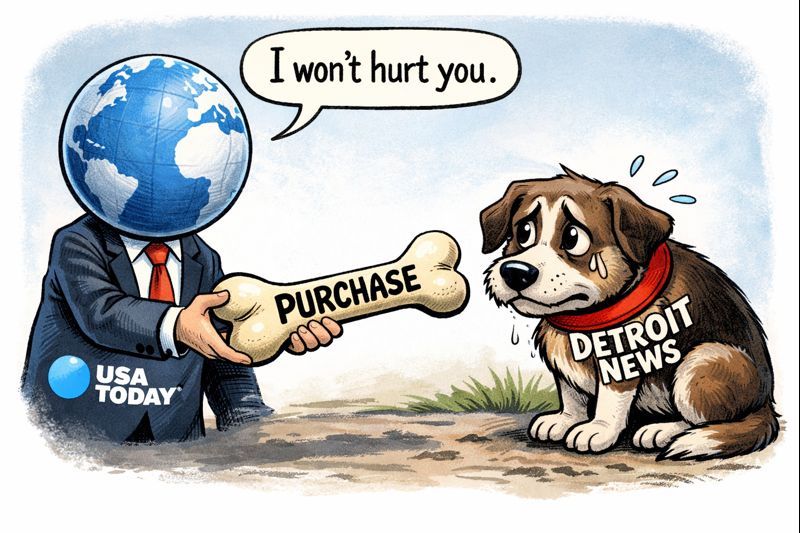
AI illustration for Deadline Detroit
So much for the Detroit News enjoying its long-awaited freedom from Gannett, the media-destroying company now hiding behind the USA Today name.
Nearly four decades ago, Gannett acquired the Detroit News, which was then locked in a do-or-die battle with the Detroit Free Press. Gannett dislikes competition even more than it dislikes quality journalism, and it quickly declared a truce with the Free Press, spearheading Justice Department approval for a so-called joint operating agreement. The JOA allowed rival newspapers to merge their business operations on the theory that doing so would preserve competing editorial voices.
Instead, Gannett decimated the News. After gaining JOA approval, it eliminated the paper’s morning edition, a crippling move given that readers increasingly preferred morning delivery.
After hollowing out the News, Gannett eventually sold it off to private-equity operators, while keeping and consolidating control of the Detroit Free Press. As I recently noted, the Detroit News somehow refused to die. Even with a small staff, it is undeniably the better newspaper, having been named Newspaper of the Year by the Michigan Press Association for three consecutive years.
Delayed Sunday Paper
The Free Press–Detroit News joint operating agreement was supposed to end on December 28. The News was set to launch its first fully independent Sunday edition on January 18. Instead, that freedom was delayed after the two organizations agreed to continue sharing certain business operations at least through March.
Gannett says it will complete its acquisition within five days. No antitrust hearings. No public comment period. No meaningful disclosures about valuation or financing, other than confirmation that private-equity giant Apollo Global Management is putting up the money.
More debt will follow, and in Gannett’s case debt has always meant layoffs, newsroom hollowing out, and publication closures. While Gannett claims it is committed to publishing the Detroit News, its long record of shrinking newsrooms, centralizing decision-making, and closing papers suggests otherwise.
There is no shortage of journalism pundits who insist that local journalism can no longer be profitable, or that American cities cannot support two competing newspapers. These arguments are typically offered as statements of economic law rather than as judgments about ownership choices, debt-fueled consolidation, and the steady financialization of newsrooms.
Detroit’s history exposes that logic as false. The city supported two strong daily newspapers for decades not because the market was irrational, but because competition produced better journalism. What failed was not local journalism, but a corporate strategy that treated newspapers as assets to be harvested rather than civic institutions to be sustained.
Losing Interest
Did hundreds of thousands of Michiganders suddenly lose interest in news affecting their state? Or did they stop subscribing because they concluded, correctly, that the paper no longer reflected their views, their work, or their lives?
The public’s growing alienation from the media is compounded by political bias that many journalists prefer to deny exists. While the Detroit News leans conservative, it nonetheless reflects elite institutional assumptions common across corporate media.
One clear example is auto industry coverage. Both the Free Press and the News cover Detroit’s automakers through the same business lens used by Bloomberg and Reuters, outlets that serve investors rather than workers. Corporate earnings and stock performance dominate the narrative, while the lived experience of company workers, engineers, and suppliers receives far less attention.
For readers whose livelihoods depend on the Detroit Three, the coverage understandably no longer feels local, instead reading like warmed-over national business news.
With a modest investment and a handful of strategic hires, the Detroit News could meaningfully outperform the Free Press and reclaim readers who have drifted away. Stronger investigative reporting, deeper labor coverage, and original commentary willing to challenge political power and orthodoxy on both sides of the aisle would sharply differentiate the publication.
National Problem
What is happening in Detroit isn’t isolated. Across the country, journalism is increasingly treated not as a public good or even a durable business, but as a corporate asset to be leveraged, stripped, and eventually discarded.
CBS News now answers to a parent company more focused on deal-making than reporting. The Washington Post, owned by Jeff Bezos, is reportedly planning layoffs of roughly 300 employees, a move that would further weaken an institution already struggling with credibility and direction.
Detroit has seen this movie before, and it has also seen resistance. When the Free Press and News first sought their joint operating agreement in the mid-1980s, local businesses including Kmart objected. So did then-Mayor Coleman Young and other Michigan leaders who understood that media consolidation carried civic consequences. Area car dealers protested the bloated advertising rates that followed once competition was extinguished.
That history is why it would not be naïve for Ford Motor Co. to speak out now. Ford’s economic commitment to Metro Detroit is unmatched, and it already employs at least four former accomplished Detroit News journalists. Challenging the acquisition, or helping catalyze a nonprofit or locally governed alternative, would not be charity. It would be an investment in the civic infrastructure that allows markets, communities, and democratic accountability to function.
Gannett will wrap this acquisition in the familiar language of scale, efficiency, and commitment to local journalism. It always does. That language has accompanied every newsroom closure, every round of layoffs, and every hollow promise the company has made for decades.
If the Detroit News is diminished or destroyed under Gannett’s control, it will not be because journalism failed, readers lost interest, or the market proved unforgiving. It will be because Gannett’s management is unfit and incapable of successfully running media properties.
Detroit has not always accepted media consolidation quietly. It would be refreshing to see today’s Metro Detroit civic leaders and residents rediscover that spine and make clear that Gannett’s Detroit News acquisition is neither welcome nor consequence-free. Canceling advertising and subscriptions would send a message even Gannett understands.
Starkman can be reached at eric@starkmanapproved.com Anonymity assured and protected.