



The writer, a Los Angeles freelancer, is a former Detroit News business reporter. This column first appeared in his blog, Starkman Approved.
By Eric Starkman
When General Motors president and future Secretary of Defense Charles Wilson appeared before Congress in 1953 and declared, “For years I thought what was good for our country was good for General Motors, and vice versa,” he was describing an economic reality at the time. In Wilson’s era, GM’s leadership, workforce, and fortunes were deeply rooted in the American industrial heartland, and the company’s success was broadly shared. What benefited GM did indeed benefit the country.

That alignment once ran deep. During World War I, roughly 90 percent of GM’s truck production was redirected to military use. In World War II, President Franklin Roosevelt tapped GM president William Knudsen to help lead America’s wartime production effort. Responsible corporate leadership and national obligation were not PR themes; they were operating assumptions. Many of the executives who ran America’s industrial giants were veterans themselves, and the idea that industry served a public purpose was widely accepted.
For decades, the bargain held. A single-income household could afford a modest home, raise a family, and buy a new car every few years without resorting to crushing debt. It was the lived experience of a large and growing middle class. The American Dream was tangible, and the auto industry helped make it so.
Those days are gone.
In 2024, the National Association of Home Builders reported that 49 percent of American households could no longer afford a median-priced $250,000 home. Housing, long the foundation of middle-class stability, had slipped out of reach for nearly half the country.
Cox Automotive last week dropped the second shoe.
The share of new-car buyers earning less than $100,000 has fallen to just 37 percent, down from 50 percent in 2020, Cox revealed. Buyers earning more than $200,000 now account for nearly a third of all new-vehicle purchases. The reason is not mysterious. The average new-car price in the United States now hovers around $51,000.
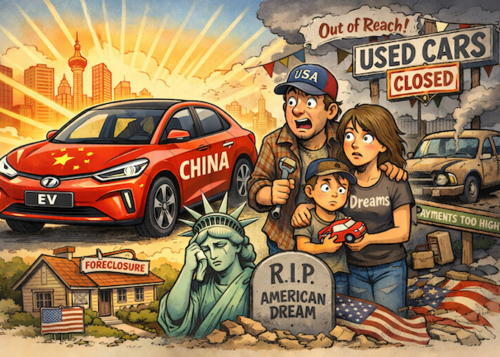
Taken together, these numbers tell a stark story. The American middle class is being priced out of the two purchases that once defined economic security: a home and a new car.

Seemingly on cue, the Wall Street Journal dropped another bombshell. After spending several weeks driving a Chinese-made electric vehicle, technology columnist Joanna Stern wrote that she would prefer never to buy an American car again.
“I fell for the SU7 Max inside and out,” Stern wrote, “and now I’m left wanting what I can’t have—at least for now.”
The Wall Street Journal once branded itself “The Daily Diary of the American Dream,” so Stern’s declaration had poetic irony. The Xiaomi SU7 Max sells for roughly $43,000 in China and is priced for a rapidly expanding Chinese middle class. General Motors, by contrast, has largely abandoned affordable vehicles in favor of high-margin trucks and SUVs, many of which cost more than what the average American earns in a year.
Put simply, what is good for China’s EV makers is good for China. What has been good for General Motors over the past decade has been far less clearly good for America.
Consider the comparison Stern set up.
The Cadillac Lyriq, with a base price of $59,520, is GM’s closest attempt at a peer to the SU7 Max. It costs roughly $16,000 more, yet delivers less range, a less cohesive software experience, and greater uncertainty about reliability. Bloomberg luxury lifestyle columnist Hannah Elliott warned years ago that Cadillac’s software and user experience lagged behind competitors, even before the Lyriq reached customers.

Elliott’s warnings proved prescient. Dealers are struggling to move the vehicle because U.S. taxpayers stopped subsidizing its sales. Consumer Reports rated the 2025 Lyriq as less reliable than other vehicles produced in the same model year, an especially troubling verdict for a flagship EV meant to justify its price through technological sophistication.
The Lyriq’s problems are not isolated. Software failures have become a recurring theme across GM’s electric lineup, undermining CEO Mary Barra’s repeated insistence that the company is now a cutting-edge technology enterprise guided by a clear EV “North Star.” GM recently recalled 80,000 Mexico-built 2025 and 2026 Chevy Equinox EVs because the software failed to generate a federally required pedestrian warning sound. The same defect had already prompted a recall of the 2024 model.
Generating a pedestrian warning signal should not test the limits of engineering competence. Yet GM continues to stumble, even as it asks American consumers to pay premium prices and accept rising debt burdens to participate in the electric future it promises but has repeatedly failed to deliver.
Meanwhile, China’s EV manufacturers are delivering increasingly sophisticated vehicles at prices calibrated to be affordable for the country’s rapidly expanding middle class, an outcome Elon Musk has publicly admired. This did not happen by chance. It reflects a broader economic transformation that has reshaped for whom China builds products.

In 2002, China’s middle-income population amounted to roughly one percent of the country, about 10 million people. By 2023, that figure had grown to an estimated 336 million people, or nearly a quarter of the population. Over the same period, America’s middle class has been hollowed out. The share of income flowing to Americans in the middle of the distribution has steadily shrunk, while gains have increasingly accrued to the top.
In 1980, Americans in the middle earned just over 52 percent of what those in the top tenth earned. By 2000, that figure had slipped below 48 percent. By 2023, it had fallen to roughly 42.5 percent. The bottom has fared even worse. According to data cited by columnist Eduardo Porter, the poorest tenth of Americans now receive about 1.8 percent of national income, a share comparable to far poorer countries. The United States has become richer overall while distributing opportunity ever more narrowly.
This matters because purchasing a vehicle is the second-costliest financial decision, surpassed only by buying a home. Car prices shape monthly budgets, determine mobility, and increasingly determine financial stability. When vehicle costs rise faster than incomes, the effects are corrosive: thinner savings and a normalization of financial fragility.
That is why China’s more affordable and technologically competitive electric vehicles carry such unsettling implications. They are priced to support middle-class expansion and broad economic prosperity. In the U.S., vehicles have increasingly been priced for the affluent, with everyone else pushed toward longer loan terms and older cars. Americans now keep their vehicles for an average of 12.6 years.
The knock on China is that it unfairly subsidized its EV industry, steals intellectual property, and pays factory workers far lower wages. Those allegations have merit. But U.S. automakers simply crying foul and demanding tariff protection is not a sustainable strategy.
BYD says it employs roughly 110,000 engineers. One might reasonably expect General Motors to be spending every available dollar of profit trying to compete. Instead, GM has authorized more than $50 billion in stock buybacks over the past three years, including the $6 billion it recently announced. Buybacks reduce the number of shares outstanding and tend to boost their value in the short term. They do nothing to make better and more globally competitive vehicles.
GM authorized its latest buyback even as salaried employees were forced to accept a more than 20 percent cut in eligible 2025 bonuses and factory workers saw their profit-sharing checks slashed by 32 percent because of CEO Mary Barra’s EV misadventures, which have already resulted in more than $7 billion in write-downs.

Barra received $29.5 million in compensation in 2024. Given her compensation record, it strains credulity to believe Barra’s 2025 pay will be cut by anything close to what GM’s workforce has absorbed. Barra previously said that executive compensation would be tied to GM’s EV success. By that standard, it is reasonable to argue she should receive no bonus at all.
This arrangement works as long as prohibitive 100 percent tariffs remain in place on China’s increasingly superior EVs, including those Chinese manufacturers build in Mexico. That is especially galling given that GM is Mexico’s largest automaker, employs roughly 25,000 workers there, and has been operating in the country for decades.
By contrast, GM can export the vehicles it builds in Mexico to the United States while paying dramatically lower tariffs. From a U.S. national-interest perspective, there is no meaningful difference between an affordable GM vehicle built in Mexico and one built by a Chinese manufacturer, particularly given that GM pays minimal federal income tax.
The undeniable truth about Trump’s and Biden’s Chinese EV tariffs is that they raise the cost of vehicles that are already beyond the reach of America’s faltering middle class. What Americans are really being asked to accept is exclusion in the name of protection — protection not for workers and growing economic prosperity but for executive compensation and short-term shareholder returns.
Starkman can be reached at eric@starkmanapproved.com Anonymity assured and protected.